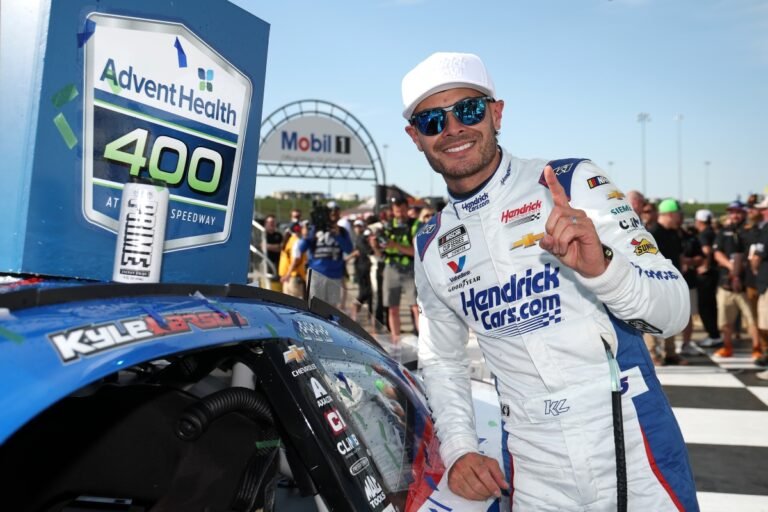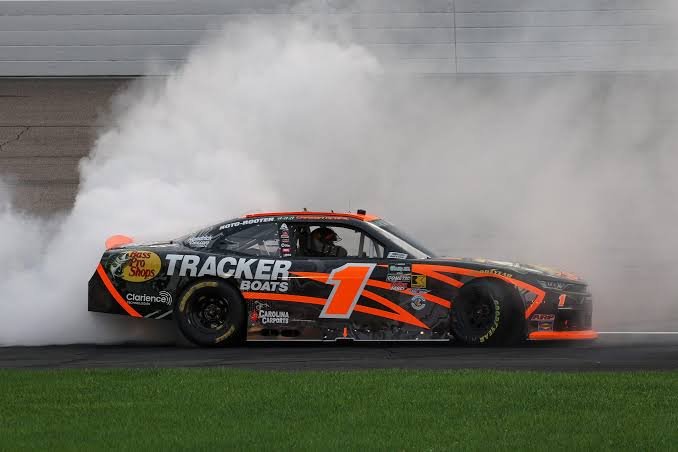
A NASCAR O’Reilly Auto Parts Series entregou mais uma corrida de alto nível em Iowa Speedway. A Hy-Vee Perks 250, disputada no sábado, 8 de agosto, terminou em cenário de muita tensão, acidentes e duas prorrogações, mas teve novamente Carson Kvapil como protagonista. Depois de conquistar sua primeira vitória na categoria em Indianapolis, Kvapil voltou à Victory Lane apenas duas semanas depois e confirmou que vive o melhor momento de sua temporada. O piloto da JR Motorsports assumiu a liderança na primeira prorrogação e resistiu ao caos para conquistar sua segunda vitória consecutiva.
Kvapil transforma boa temporada em candidatura ao título
O momento de Carson Kvapil merece atenção. O piloto do Chevrolet nº 1 havia passado suas primeiras 63 largadas na O’Reilly Series sem vencer. Agora, em apenas duas corridas, conseguiu duas vitórias consecutivas. A sequência começou em Indianapolis, onde Kvapil derrotou o próprio companheiro de equipe Justin Allgaier, e continuou em Iowa, em pista completamente diferente e muito mais exigente fisicamente. Mais do que as vitórias, o desempenho mostra evolução importante do conjunto comandado por Rodney Childers. A equipe conseguiu encontrar velocidade tanto em circuito de 2,5 milhas como Indianapolis quanto no oval curto de 0,875 milha de Iowa. Essa capacidade de adaptação pode ser fundamental para Kvapil quando começar o Chase.
Uma corrida decidida no caos
Iowa foi praticamente dividida em duas corridas. Durante boa parte dos 250 giros previstos, Ryan Sieg e Ross Chastain estiveram entre os principais nomes da disputa. Sieg largou da pole e venceu o primeiro estágio, enquanto Chastain também apareceu constantemente na frente. A situação mudou completamente nas voltas finais. Uma cautela provocada por Jeb Burton levou a prova para a primeira prorrogação. No reinício, Kvapil conseguiu superar Chastain e assumir a liderança.
O problema para os adversários foi que um acidente envolvendo vários carros, com oito competidores na Curva 2, provocou nova bandeira amarela. A corrida foi novamente para overtime. Na segunda tentativa, Kvapil conseguiu controlar o reinício e abrir vantagem suficiente para garantir a vitória. Rajah Caruth aproveitou a movimentação atrás dos líderes para avançar para segundo, terminando apenas 0s343 atrás do vencedor. Foi uma demonstração importante de maturidade: Kvapil não precisava dominar a prova inteira, apenas estar na posição certa quando a corrida realmente fosse decidida.
Rajah Caruth consegue seu melhor resultado
Se Kvapil foi o grande vencedor da noite, Rajah Caruth também saiu de Iowa com motivos para comemorar. O segundo lugar foi o melhor resultado da carreira do piloto na O’Reilly Series. Mais importante ainda, o resultado veio em momento extremamente importante na luta pelo Chase. Antes da etapa, Caruth estava abaixo da linha de corte. O desempenho em Iowa reduziu significativamente a pressão para a última corrida da temporada regular. Caruth conseguiu maximizar uma situação complicada e mostrou justamente o tipo de resultado que um piloto precisa buscar quando está lutando por vaga no campeonato.
Sheldon Creed também ganha terreno
Sheldon Creed terminou em quinto e conseguiu outro resultado importante na briga pelo campeonato. O piloto já estava classificado para o Chase, mas cada ponto conquistado nesta fase pode fazer diferença para definir sua posição inicial no campeonato. A situação é particularmente interessante porque a temporada regular está chegando ao fim. A última corrida antes do Chase será disputada em Daytona, circuito em que acidentes e estratégias podem provocar mudanças enormes na classificação.
A grande preocupação: a disputa pelo corte
O resultado de Iowa também aumentou a pressão sobre os pilotos que ainda não garantiram vaga no Chase. Antes da etapa, William Sawalich e Rajah Caruth estavam abaixo da linha de corte, enquanto Taylor Gray ocupava a última posição dentro da zona de classificação. Com apenas Daytona restando na temporada regular, cada ponto passa a ter peso enorme. A situação é ainda mais perigosa porque Daytona é pista de superspeedway. Ou seja, não basta analisar simplesmente quem tem o melhor ritmo. Estratégia, posicionamento no pelotão, trabalho em equipe e, principalmente, sobrevivência serão fundamentais.
JR Motorsports continua dominando
Outro ponto que merece destaque é o momento da JR Motorsports. A organização conseguiu vencer em Indianapolis com Kvapil e voltou a vencer em Iowa com o mesmo piloto. Além disso, Rajah Caruth terminou em segundo, reforçando a força do equipamento Chevrolet da equipe. A vitória em Iowa foi também a 15ª da JR Motorsports na temporada, depois de a equipe ter chegado a Indianapolis com 14 triunfos. Em Indianapolis, a organização havia conseguido ainda um histórico 1-2-3-4, com Kvapil, Allgaier, Ross Chastain e Chase Elliott. O momento da JRM mostra que a equipe não depende exclusivamente de um piloto. Allgaier continua sendo a referência do campeonato, mas Kvapil aparece cada vez mais como candidato real ao título.
Ryan Sieg: uma das histórias mais frustrantes da corrida
Ryan Sieg foi outro nome que merece destaque. O piloto conquistou a pole e venceu o primeiro estágio, mostrando que tinha velocidade suficiente para brigar pela vitória. Entretanto, a corrida acabou escapando de suas mãos nas voltas finais. O cenário de Iowa resume bem a dificuldade de uma corrida de short track: ter um carro rápido não é suficiente. É necessário sobreviver às bandeiras amarelas, aos reinícios e ao caos das últimas voltas. Sieg terminou sem transformar a excelente velocidade demonstrada durante a maior parte da prova em resultado compatível.
Iowa reforça tendência da temporada
A etapa também confirma característica muito forte da O’Reilly Series em 2026: as corridas estão sendo decididas cada vez mais nos momentos finais. A prova de Iowa terminou com duas prorrogações e foi marcada por série de acidentes na parte final. Esse tipo de situação já havia aparecido em outras etapas da temporada, como EchoPark, que também terminou em double overtime. Isso cria uma categoria extremamente imprevisível. Mesmo quando um piloto parece ter a corrida controlada, uma única bandeira amarela pode mudar completamente a estratégia e colocar vários concorrentes novamente na disputa.
O que esperar de Daytona?
Agora, toda a atenção se volta para Daytona International Speedway. A Winn-Dixie 250, marcada para 28 de agosto, será a última corrida da temporada regular antes do início do Chase em Darlington. Para Kvapil, o objetivo será diferente. Com a vaga já garantida, ele pode entrar em Daytona pensando principalmente em somar pontos e preservar o equipamento. Para os pilotos próximos da linha de corte, porém, a corrida terá peso enorme. E é justamente aí que Daytona pode produzir uma das maiores reviravoltas da temporada.
Conclusão
A etapa de Iowa não foi apenas mais uma vitória para Carson Kvapil. Foi a confirmação de que o piloto da JR Motorsports entrou definitivamente na conversa pelo campeonato. Depois de passar mais de 60 corridas buscando sua primeira vitória, Kvapil agora tem duas consecutivas e chega ao final da temporada regular com confiança, velocidade e uma equipe extremamente competitiva. O Chase ainda nem começou, mas a disputa pelo título já ganhou um novo protagonista. Carson Kvapil deixou de ser apenas uma promessa. Em Iowa, ele mostrou que pode ser um dos pilotos a serem batidos na fase decisiva da temporada.
Carson Kvapil Confirms Strong Form and Wins at Iowa in Chaotic Finish
The NASCAR O’Reilly Auto Parts Series delivered another high-level race at Iowa Speedway. The Hy-Vee Perks 250, held on Saturday, August 8, ended in a scenario of great tension, accidents, and two overtime periods, but once again had Carson Kvapil as the protagonist. After scoring his first series victory at Indianapolis, Kvapil returned to Victory Lane just two weeks later and confirmed that he is living the best moment of his season. The JR Motorsports driver took the lead in the first overtime and resisted the chaos to secure his second consecutive win.
Kvapil Turns Strong Season into Title Contention
Carson Kvapil’s current form deserves attention. The driver of the No. 1 Chevrolet had gone through his first 63 O’Reilly Series starts without a win. Now, in just two races, he has earned back-to-back victories. The streak began at Indianapolis, where Kvapil defeated his own JR Motorsports teammate Justin Allgaier, and continued at Iowa — a completely different and far more physically demanding track. More than the wins, the performance shows important evolution from the team led by Rodney Childers. The group found speed both on a 2.5-mile track like Indianapolis and on the 0.875-mile short oval at Iowa. That adaptability could prove fundamental for Kvapil once the Chase begins.
A Race Decided in Chaos
Iowa was practically split into two races. For much of the scheduled 250 laps, Ryan Sieg and Ross Chastain were among the main names in the battle. Sieg started from pole and won the first stage, while Chastain also appeared constantly at the front. The situation changed completely in the closing laps. A caution triggered by Jeb Burton sent the race into its first overtime. On the restart, Kvapil managed to pass Chastain and take the lead.
The problem for his rivals was that a multi-car accident involving eight competitors in Turn 2 triggered another yellow flag. The race went to overtime again. On the second attempt, Kvapil controlled the restart and opened enough of a gap to secure the victory. Rajah Caruth took advantage of the movement behind the leaders to advance to second, finishing just 0.343 seconds behind the winner. It was an important display of maturity: Kvapil did not need to dominate the entire race. He only needed to be in the right position when the race was truly decided.
Rajah Caruth Achieves Career-Best Result
If Kvapil was the big winner of the night, Rajah Caruth also left Iowa with reasons to celebrate. The second-place finish was the best result of the driver’s O’Reilly Series career. Even more importantly, it came at an extremely crucial moment in the Chase battle. Before the round, Caruth was below the cut line. The performance at Iowa significantly reduced the pressure for the final race of the regular season. Caruth managed to maximize a complicated situation and showed exactly the kind of result a driver needs when fighting for a championship spot.
Sheldon Creed Also Gains Ground
Sheldon Creed finished fifth and secured another important result in the championship fight. The driver was already locked into the Chase, but every point earned at this stage can make a difference in defining his starting position for the championship. The situation is particularly interesting because the regular season is coming to an end. The final race before the Chase will be held at Daytona, a circuit where accidents and strategies can cause huge changes in the standings.
The Big Concern: The Cutoff Battle
The Iowa result also increased pressure on drivers who have not yet guaranteed a Chase spot. Before the round, William Sawalich and Rajah Caruth were below the cut line, while Taylor Gray occupied the last position inside the qualification zone. With only Daytona remaining in the regular season, every point now carries enormous weight. The situation is even more dangerous because Daytona is a superspeedway. In other words, it is not enough to simply analyze who has the best pace. Strategy, positioning in the pack, teamwork, and above all survival will be fundamental.
JR Motorsports Continues to Dominate
Another point worth highlighting is JR Motorsports’ current form. The organization won at Indianapolis with Kvapil and won again at Iowa with the same driver. In addition, Rajah Caruth finished second, reinforcing the strength of the team’s Chevrolet equipment. The Iowa victory was also JR Motorsports’ 15th of the season, after the team arrived at Indianapolis with 14 wins. At Indianapolis, the organization had even achieved a historic 1-2-3-4 with Kvapil, Allgaier, Ross Chastain, and Chase Elliott. JRM’s momentum shows that the team does not rely exclusively on one driver. Allgaier remains the championship benchmark, but Kvapil is increasingly emerging as a real title contender.
Ryan Sieg: One of the Race’s Most Frustrating Stories
Ryan Sieg was another name worth noting. The driver took pole and won the first stage, showing he had enough speed to fight for victory. However, the race slipped away from him in the final laps. The Iowa scenario perfectly summarizes the difficulty of a short-track race: having a fast car is not enough. You must survive the yellow flags, the restarts, and the chaos of the closing laps. Sieg ended the day without converting the excellent speed he showed for most of the race into a matching result.
Iowa Reinforces a Season Trend
The round also confirms a very strong characteristic of the 2026 O’Reilly Series: races are being decided more and more in the final moments. The Iowa race ended with two overtime periods and was marked by a series of accidents in the closing stage. This type of situation had already appeared in other rounds this season, such as EchoPark, which also ended in double overtime. This creates an extremely unpredictable category. Even when a driver seems to have the race under control, a single yellow flag can completely change the strategy and put several competitors back in the battle.
What to Expect from Daytona?
Now, all attention turns to Daytona International Speedway. The Winn-Dixie 250, scheduled for August 28, will be the final race of the regular season before the Chase begins at Darlington. For Kvapil, the goal will be different. With his spot already secured, he can approach Daytona mainly thinking about scoring points and preserving equipment. For drivers near the cut line, however, the race will carry enormous weight. And it is precisely there that Daytona could produce one of the biggest twists of the season.
Conclusion
The Iowa round was not just another win for Carson Kvapil. It was confirmation that the JR Motorsports driver has definitively entered the championship conversation. After spending more than 60 races searching for his first victory, Kvapil now has two in a row and arrives at the end of the regular season with confidence, speed, and an extremely competitive team. The Chase has not even started yet, but the title fight has already gained a new protagonist. Carson Kvapil is no longer just a promise. At Iowa, he showed that he can be one of the drivers to beat in the decisive phase of the season.
Por: Ana Elisa
@ana_arquiteturaevelocidade
Tradução: Autoral
Informações/dados: Nascar
NASCAR CUP
Ty Gibbs vence em Iowa e transforma a disputa pelo campeonato
A passagem da NASCAR Cup Series por Iowa Speedway entregou uma das corridas mais importantes da reta final da temporada regular de 2026. Em uma pista curta, de apenas 0,875 milha, a etapa exigiu precisão, gerenciamento dos pneus, estratégia de pit stops e, principalmente, capacidade de sobreviver ao caos. No fim, Ty Gibbs saiu como o grande vencedor, enquanto a disputa pelo topo do campeonato ganhou uma nova configuração.
Ty Gibbs confirma evolução nos short tracks
A vitória de Ty Gibbs foi muito mais do que um segundo triunfo na temporada. O piloto da Joe Gibbs Racing mostrou novamente que seu desempenho nos circuitos curtos deixou de ser uma promessa e passou a ser uma das suas principais forças. Gibbs terminou em quarto no primeiro estágio, recuperou-se de um problema no pit stop que o fez perder cerca de 25 posições e, posteriormente, voltou a disputar a liderança.
A decisão que mudou a corrida aconteceu na volta 290, quando a equipe optou por colocar apenas dois pneus novos no Toyota #54. A estratégia permitiu que Gibbs saísse à frente de Christopher Bell e, depois da última sequência de pit stops, assumisse definitivamente a liderança. Bell pressionou durante as últimas voltas, mas Gibbs não cometeu erros. O piloto de 23 anos conseguiu controlar o ritmo e conquistou sua primeira vitória em Iowa e a segunda da temporada.
O resultado também reforça um dado importante: Gibbs terminou entre os quatro primeiros em todas as quatro pistas curtas disputadas pela Cup Series em 2026, mostrando uma consistência que pode ser extremamente valiosa durante o Chase.
Christopher Bell novamente fica com o segundo lugar
Para Christopher Bell, Iowa representou mais uma oportunidade perdida. O piloto do Toyota #20 terminou em segundo, chegando à sua sétima segunda colocação da temporada e à quarta nas últimas cinco corridas. O resultado foi suficiente para fazê-lo subir de décimo para sexto no campeonato, mas o sentimento depois da prova foi de frustração.
Bell tinha um carro competitivo e chegou a dominar boa parte do segundo estágio, mas não conseguiu encontrar uma maneira de superar Gibbs na parte final. A situação chama atenção porque Bell continua acumulando resultados fortes, mas está transformando possíveis vitórias em segundos lugares. Em uma temporada em que a regularidade será importante para o Chase, os pontos estão chegando, mas as vitórias continuam sendo fundamentais para construir confiança.
Ryan Blaney volta a mostrar força em Iowa
Outro destaque foi Ryan Blaney. O piloto da Team Penske largou da pole, venceu o primeiro estágio e liderou 129 das 350 voltas, maior número da corrida. No entanto, não conseguiu transformar o domínio inicial em vitória e terminou em terceiro.
Mesmo assim, Iowa voltou a confirmar a excelente relação entre Blaney e o circuito. Ele venceu a primeira corrida da Cup Series em Iowa, em 2024, liderando 201 voltas, e terminou em quarto em 2025, quando ainda liderou outras 29 voltas. Em 2026, novamente esteve entre os protagonistas. Para Blaney, o resultado também foi importante na luta pela parte de cima da tabela.
Denny Hamlin sobrevive e amplia liderança
Se Gibbs foi o grande vencedor da corrida, Denny Hamlin foi um dos grandes vencedores do campeonato. O piloto da Joe Gibbs Racing enfrentou problemas de freio e precisou largar do fundo do pelotão. Mesmo assim, conseguiu avançar durante a prova e terminou em quinto.
Mais importante: Hamlin ampliou sua vantagem no campeonato para 103 pontos sobre Ty Gibbs. O resultado mostra justamente uma das características que pode definir o campeão de 2026: capacidade de transformar dias difíceis em resultados sólidos. Enquanto alguns dos seus principais adversários tiveram problemas graves, Hamlin conseguiu minimizar as perdas e ainda saiu de Iowa com uma vantagem maior.
O desastre de Tyler Reddick
Um dos acontecimentos mais importantes da corrida aconteceu logo no início. Na quarta volta, Tyler Reddick perdeu o controle do Toyota #45 na entrada da primeira curva e acabou atingindo o carro de Erik Jones. Os dois ficaram fora da corrida. Reddick terminou em 36º, enquanto Jones ficou em 35º.
O impacto no campeonato foi enorme. Reddick chegou a Iowa como segundo colocado na tabela, mas deixou o circuito em quarto, agora 120 pontos atrás de Hamlin, com apenas três corridas restantes antes do Chase. É um golpe especialmente forte para um piloto que dominou boa parte da primeira metade da temporada e chegou a acumular cinco vitórias. O momento de Reddick, portanto, mudou completamente. A questão agora não é mais apenas conquistar o título da temporada regular, mas recuperar confiança e velocidade antes da definição do grid do Chase.
Kyle Larson continua vivendo uma temporada complicada
Iowa também foi mais um capítulo negativo para Kyle Larson. O piloto da Hendrick Motorsports largou em segundo e terminou o primeiro estágio em terceiro, mas acabou envolvido em um acidente na volta 149. Uma situação de quatro carros acabou deixando Larson em posição extremamente complicada. O Chevrolet #5 sofreu danos e o piloto terminou a corrida em 33º, 18 voltas atrás do líder.
O mais preocupante é que Iowa já havia sido um circuito difícil para Larson nas duas primeiras visitas da Cup Series. Em 2024, ele liderou 80 voltas antes de abandonar e terminar em 34º; em 2025, terminou em 28º. Ou seja, Iowa voltou a ser um dos pontos fracos da temporada de Larson. E isso acontece justamente em um momento delicado para a Hendrick Motorsports, que precisa encontrar respostas antes da chegada do Chase.
William Byron não consegue repetir a vitória
O atual vencedor de Iowa, William Byron, também não conseguiu repetir o desempenho de 2025. Byron terminou em nono, depois de uma primeira metade de corrida complicada. O piloto da Hendrick Motorsports havia chegado a Iowa como um dos grandes favoritos justamente pelo histórico recente: venceu a corrida de 2025 liderando 141 voltas e havia terminado em segundo na edição inaugural de 2024.
Mesmo sem repetir o resultado dos dois anos anteriores, o top 10 ajuda Byron em um momento no qual a classificação do campeonato exige regularidade.
Chase Briscoe continua em alta
Chase Briscoe também merece destaque. O piloto da Joe Gibbs Racing terminou em sexto e manteve a sequência de resultados fortes que vem construindo nas últimas semanas.
Briscoe já havia terminado em segundo em Iowa em 2025, depois de liderar 81 voltas, e chegou à corrida de 2026 vindo de uma sequência extremamente positiva, incluindo vitória em Chicagoland e quarto lugar em Indianapolis. Mesmo sem vencer, o sexto lugar reforça a sensação de que Briscoe pode ser um dos pilotos mais perigosos quando o Chase começar.
O campeonato muda de cenário
O resultado de Iowa foi particularmente importante porque faltam agora apenas três corridas para o início do Chase. Antes da etapa, Denny Hamlin liderava com 886 pontos, seguido por Tyler Reddick, Ryan Blaney e Ty Gibbs. Gibbs estava em quarto, 135 pontos atrás de Hamlin.
Depois de Iowa, Gibbs saltou para segundo e Reddick caiu para quarto. Hamlin, por outro lado, ampliou sua vantagem para 103 pontos sobre Gibbs. Essa mudança é importante porque a regularidade na fase final da temporada regular determinará a posição de largada para o Chase e, consequentemente, a quantidade de pontos com que cada piloto começará a disputa pelo título.
Iowa mostrou quem está preparado para o Chase
Mais do que definir um vencedor, Iowa funcionou como um teste para os principais candidatos ao campeonato.
Ty Gibbs saiu fortalecido, mostrando velocidade e capacidade de recuperação.
Christopher Bell continua extremamente competitivo, mas precisa transformar seus segundos lugares em vitórias.
Ryan Blaney confirmou novamente sua força em Iowa e permanece como um dos nomes mais consistentes da temporada.
Denny Hamlin mostrou que mesmo uma corrida complicada pode terminar a seu favor.
Já Tyler Reddick e Kyle Larson saíram de Iowa precisando de uma reação imediata.
Com apenas três provas restantes na temporada regular, a NASCAR entra em uma fase na qual cada erro pode custar posições importantes no grid do Chase.
E, depois de Iowa, uma coisa ficou clara: Ty Gibbs deixou de ser apenas uma promessa para se tornar um candidato real ao título de 2026.
A vitória em Iowa não apenas colocou o piloto da Joe Gibbs Racing no segundo lugar do campeonato, mas também mostrou que ele chega ao momento decisivo da temporada em uma crescente de desempenho que pode fazer toda a diferença quando o campeonato entrar em sua fase eliminatória.
Ty Gibbs Wins at Iowa and Transforms the Championship Battle
The NASCAR Cup Series’ visit to Iowa Speedway delivered one of the most important races of the 2026 regular season final stretch. On a short track of just 0.875 miles, the round demanded precision, tire management, pit stop strategy, and above all the ability to survive chaos. In the end, Ty Gibbs emerged as the big winner, while the battle for the top of the championship gained a new configuration.
Ty Gibbs Confirms Short-Track Evolution
Ty Gibbs’ victory was much more than a second win of the season. The Joe Gibbs Racing driver once again showed that his performance on short tracks has moved from promise to become one of his main strengths. Gibbs finished fourth in the first stage, recovered from a pit stop problem that cost him about 25 positions, and later returned to battle for the lead.
The decision that changed the race came on lap 290, when the team opted to put only two new tires on the No. 54 Toyota. The strategy allowed Gibbs to exit ahead of Christopher Bell, and after the final sequence of pit stops, he took the lead for good. Bell pressured him during the closing laps, but Gibbs made no mistakes. The 23-year-old driver managed to control the pace and secured his first victory at Iowa and his second of the season.
The result also reinforces an important statistic: Gibbs finished in the top four at all four short tracks visited by the Cup Series in 2026, showing a consistency that could prove extremely valuable during the Chase.
Christopher Bell Finishes Second Again
For Christopher Bell, Iowa represented another missed opportunity. The No. 20 Toyota driver finished second, earning his seventh runner-up finish of the season and his fourth in the last five races. The result was enough to move him from tenth to sixth in the championship, but the feeling after the race was one of frustration.
Bell had a competitive car and even dominated much of the second stage, but could not find a way to beat Gibbs in the final portion. The situation draws attention because Bell continues to accumulate strong results but is turning potential victories into second-place finishes. In a season where consistency will be important for the Chase, the points are coming, but wins remain essential to build confidence.
Ryan Blaney Shows Strength at Iowa Again
Another highlight was Ryan Blaney. The Team Penske driver started from pole, won the first stage, and led 129 of the 350 laps — the highest number in the race. However, he could not convert his early dominance into victory and finished third.
Even so, Iowa once again confirmed Blaney’s excellent relationship with the circuit. He won the first Cup Series race at Iowa in 2024, leading 201 laps, and finished fourth in 2025 after leading another 29 laps. In 2026, he was once again among the protagonists. For Blaney, the result was also important in the fight for the top of the standings.
Denny Hamlin Survives and Extends Lead
If Gibbs was the big winner of the race, Denny Hamlin was one of the big winners in the championship. The Joe Gibbs Racing driver faced brake problems and had to start from the back of the field. Even so, he managed to advance during the race and finished fifth.
More importantly: Hamlin extended his championship lead to 103 points over Ty Gibbs. The result shows exactly one of the characteristics that could define the 2026 champion: the ability to turn difficult days into solid results. While some of his main rivals had serious problems, Hamlin managed to minimize the losses and still left Iowa with a larger advantage.
Tyler Reddick’s Disaster
One of the most important events of the race happened early. On lap 4, Tyler Reddick lost control of the No. 45 Toyota at the entrance to Turn 1 and ended up hitting Erik Jones’ car. Both were out of the race. Reddick finished 36th, while Jones ended up 35th.
The impact on the championship was enormous. Reddick arrived at Iowa as the second-place driver in the standings but left the circuit in fourth, now 120 points behind Hamlin, with only three races remaining before the Chase. It is a particularly hard blow for a driver who dominated much of the first half of the season and had accumulated five wins. Reddick’s moment, therefore, has changed completely. The question now is no longer just about winning the regular season title, but recovering confidence and speed before the Chase grid is set.
Kyle Larson Continues to Struggle
Iowa was also another negative chapter for Kyle Larson. The Hendrick Motorsports driver started second and finished the first stage in third, but was involved in an accident on lap 149. A four-car incident left Larson in an extremely complicated position. The No. 5 Chevrolet suffered damage and the driver finished the race in 33rd, 18 laps down.
The most concerning part is that Iowa had already been a difficult circuit for Larson in the Cup Series’ first two visits. In 2024, he led 80 laps before retiring and finishing 34th; in 2025, he finished 28th. In other words, Iowa has once again become one of the weak points of Larson’s season. And this happens at a delicate moment for Hendrick Motorsports, which needs to find answers before the Chase arrives.
William Byron Cannot Repeat Victory
The defending Iowa winner, William Byron, also could not repeat his 2025 performance. Byron finished ninth after a complicated first half of the race. The Hendrick Motorsports driver had arrived at Iowa as one of the big favorites precisely because of his recent history: he won the 2025 race leading 141 laps and had finished second in the inaugural 2024 edition.
Even without matching the results of the previous two years, the top-10 finish helps Byron at a time when the championship standings demand consistency.
Chase Briscoe Continues His Strong Run
Chase Briscoe also deserves mention. The Joe Gibbs Racing driver finished sixth and maintained the strong sequence of results he has been building in recent weeks.
Briscoe had already finished second at Iowa in 2025 after leading 81 laps, and arrived at the 2026 race coming off an extremely positive streak, including a win at Chicagoland and a fourth-place finish at Indianapolis. Even without winning, the sixth-place result reinforces the sense that Briscoe could be one of the most dangerous drivers when the Chase begins.
The Championship Changes Shape
The Iowa result was particularly important because there are now only three races left before the Chase begins. Before the round, Denny Hamlin led with 886 points, followed by Tyler Reddick, Ryan Blaney, and Ty Gibbs. Gibbs was fourth, 135 points behind Hamlin.
After Iowa, Gibbs jumped to second and Reddick fell to fourth. Hamlin, on the other hand, extended his advantage to 103 points over Gibbs. This shift is important because consistency in the final phase of the regular season will determine starting positions for the Chase and, consequently, the number of points with which each driver begins the title fight.
Iowa Showed Who Is Ready for the Chase
More than defining a winner, Iowa served as a test for the main championship contenders.
Ty Gibbs left strengthened, showing speed and recovery ability.
Christopher Bell remains extremely competitive but needs to turn his second-place finishes into wins.
Ryan Blaney once again confirmed his strength at Iowa and remains one of the most consistent names of the season.
Denny Hamlin showed that even a complicated race can end in his favor.
Tyler Reddick and Kyle Larson left Iowa needing an immediate reaction.
With only three races remaining in the regular season, NASCAR enters a phase where every mistake can cost important positions on the Chase grid.
And after Iowa, one thing became clear: Ty Gibbs is no longer just a promise. He has become a real contender for the 2026 title.
The victory at Iowa not only put the Joe Gibbs Racing driver into second place in the championship, but also showed that he arrives at the decisive moment of the season on a performance upswing that could make all the difference when the championship enters its elimination phase.
Por: Ana Elisa
@ana_arquiteturaevelocidade
Tradução: Autoral
Informações/dados: Nascar