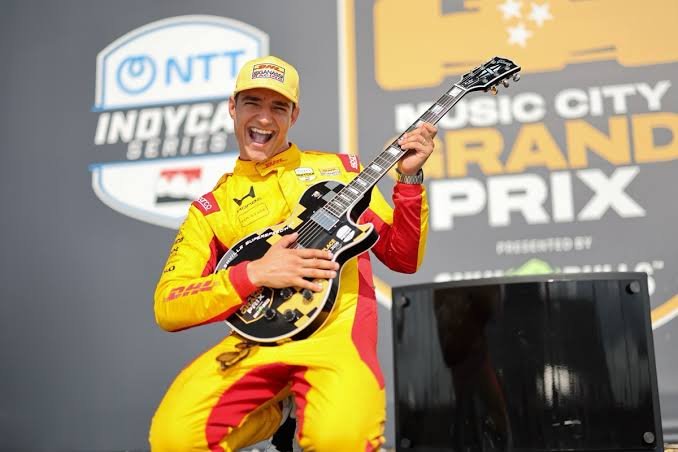
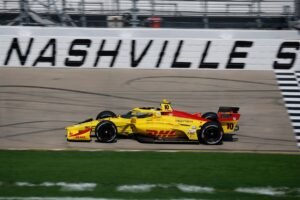
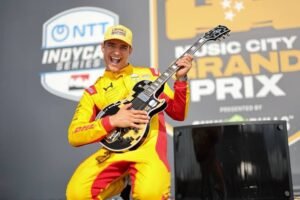
A IndyCar viveu um dos fins de semana mais movimentados da temporada no Nashville Superspeedway. A etapa de 2026 reuniu praticamente todos os elementos que tornam o automobilismo americano tão imprevisível: um oval de alta velocidade e extremamente exigente, um forte acidente durante os treinos, mudanças na programação provocadas pelo clima, uma corrida adiada para segunda-feira e uma disputa estratégica que terminou com mais uma vitória de Álex Palou.
O espanhol chegou ao Tennessee como líder do campeonato e deixou Nashville ainda mais confortável na primeira posição. Com o triunfo, Palou conquistou sua quinta vitória na temporada e ampliou para 83 pontos a vantagem sobre David Malukas, consolidando uma campanha cada vez mais dominante na luta pelo título.
Antes, porém, de comemorar mais uma vitória, Palou e a Chip Ganassi Racing acompanharam de perto uma das principais preocupações do fim de semana: o forte acidente de um dos principais adversários do espanhol na disputa pelo campeonato.
O forte acidente de David Malukas
O primeiro grande momento da etapa aconteceu ainda no primeiro treino livre.
David Malukas perdeu o controle do carro #12 da Team Penske na curva 2 do Nashville Superspeedway e sofreu um forte impacto contra o muro externo. O acidente provocou a interrupção da sessão e imediatamente levantou dúvidas sobre a participação do piloto no restante do evento.
Nashville é um circuito particularmente exigente para pilotos e equipes. O oval de alta velocidade conta com uma superfície de concreto, bumps significativos e pouca margem para erros. Durante o treino, outros competidores também enfrentaram dificuldades para encontrar o equilíbrio ideal dos carros, deixando claro que as condições da pista teriam um papel importante ao longo do fim de semana.
Malukas foi encaminhado para avaliação médica após o acidente e apresentou dores no joelho direito. Depois dos exames, entretanto, recebeu autorização para continuar competindo.
A partir daquele momento, sua participação na etapa se transformou em uma das principais histórias do fim de semana.
Do acidente ao pódio
Malukas precisou largar apenas da 24ª posição, mas conseguiu transformar um cenário que parecia completamente desfavorável em uma das maiores recuperações da temporada.
Em uma corrida extremamente desgastante, o piloto da Team Penske avançou pelo pelotão e recebeu a bandeira quadriculada na terceira posição.
O resultado ganha ainda mais importância quando se considera todo o contexto. Malukas havia sofrido um forte acidente no início do evento, precisou passar por avaliação médica e ainda enfrentou uma corrida marcada pelo calor extremo e por uma programação completamente alterada pelas condições climáticas.
O terceiro lugar, portanto, representou muito mais do que um simples bom resultado.
Foi uma demonstração de resistência física, velocidade e capacidade de adaptação.
Malukas conseguiu superar as dificuldades de um fim de semana que começou da pior maneira possível e, ao mesmo tempo, deixou Nashville ainda como o principal perseguidor de Palou na classificação do campeonato.
A diferença de 83 pontos é significativa, mas o piloto da Penske continua sendo uma das principais ameaças ao domínio do espanhol na temporada.
A corrida que começou no domingo e terminou na segunda-feira
Se o acidente de Malukas foi o primeiro grande acontecimento da etapa, o clima foi responsável por transformar completamente a programação do evento.
A corrida estava originalmente marcada para domingo, mas o cronograma já havia sido impactado pela final da Copa do Mundo de 2026, disputada entre Espanha e Argentina. A partida avançou até a prorrogação, enquanto a IndyCar aguardava para dar sequência à programação.
Depois, a chuva voltou a aparecer sobre Nashville.
A organização tentou secar a pista e manter a possibilidade de realizar a corrida ainda no domingo. As luzes do circuito foram utilizadas durante o processo, mas uma nova tempestade atingiu a região e tornou impossível seguir com a programação.
A decisão acabou sendo inevitável: a corrida precisou ser adiada para segunda-feira.
O início foi remarcado para o período da tarde, em uma situação pouco comum para a IndyCar e que alterou completamente a preparação das equipes e dos pilotos.
Em um oval de alta velocidade, não existe espaço para improvisos quando a pista está molhada. A segurança dos competidores depende de uma superfície completamente seca e de condições adequadas para que os carros possam atingir velocidades extremamente altas.
Nashville acabou se tornando, portanto, uma prova de resistência também fora da pista.
O calor extremo também mudou a estratégia
O adiamento provocado pela chuva não foi o único impacto causado pelas condições climáticas.
O calor extremo enfrentado em Nashville fez com que a IndyCar reduzisse a distância planejada da corrida.
A prova, originalmente programada para 300 voltas, foi reduzida para 225.
A alteração mudou completamente a dinâmica estratégica do evento.
Uma corrida mais curta significa menos oportunidades de recuperação e uma janela estratégica muito mais apertada. Ao mesmo tempo, as altas temperaturas aumentaram o desgaste físico dos pilotos e tornaram ainda mais importante o gerenciamento dos pneus e da temperatura dos carros.
Cada parada nos boxes passou a ter um peso ainda maior.
Em uma corrida de oval, uma simples bandeira amarela já pode transformar completamente o cenário. Com menos voltas disponíveis, qualquer erro estratégico pode significar a perda definitiva de posições importantes.
Foi justamente nesse cenário que Álex Palou voltou a mostrar por que é o líder do campeonato.
Palou novamente no lugar certo
Álex Palou conquistou sua quinta vitória da temporada e ampliou ainda mais sua vantagem na classificação.
O piloto da Chip Ganassi Racing não precisou dominar todas as voltas para vencer. Mais uma vez, demonstrou uma das características que se tornaram marcas registradas de sua campanha: a capacidade de tomar as decisões certas nos momentos decisivos.
Um dos momentos mais importantes aconteceu antes da segunda bandeira amarela da corrida.
Palou havia acabado de entrar nos boxes, poucos décimos de segundo antes do fechamento do pit lane, quando a neutralização foi acionada após um incidente envolvendo Scott Dixon e Alexander Rossi.
Em uma corrida de oval, esse tipo de detalhe pode definir o resultado de uma prova.
Enquanto alguns pilotos ficam presos na pista e perdem a oportunidade de realizar sua parada, quem consegue entrar nos boxes antes da bandeira amarela ganha uma enorme vantagem estratégica.
Palou, mais uma vez, estava do lado certo da situação.
Essa capacidade de aproveitar pequenas oportunidades é uma das principais razões pelas quais o espanhol conseguiu construir uma vantagem tão significativa no campeonato.
Josef Newgarden fica novamente perto da vitória
Se Palou deixou Nashville comemorando, Josef Newgarden teve motivos para sair frustrado.
O piloto da Team Penske esteve na disputa pelas primeiras posições e chegou a brigar diretamente pela vitória, mas não conseguiu superar o espanhol na fase decisiva da corrida.
Para Newgarden, o resultado representa mais uma oportunidade perdida em uma temporada na qual a Penske continua tentando encontrar a consistência necessária para desafiar a Chip Ganassi Racing.
O desempenho da equipe, entretanto, mostrou competitividade.
A Penske colocou David Malukas no pódio e teve Newgarden disputando a vitória. O problema é que, mais uma vez, o resultado final acabou favorecendo Palou.
E esse cenário pode ser decisivo na luta pelo campeonato.
Palou não precisa necessariamente dominar todas as corridas. Se continuar vencendo enquanto seus principais adversários dividem pontos e oportunidades entre si, sua vantagem continuará crescendo.
Foi exatamente o que aconteceu em Nashville.
Scott Dixon e Alexander Rossi protagonizam incidente
A segunda das três bandeiras amarelas da corrida aconteceu após um incidente envolvendo Scott Dixon e Alexander Rossi.
O episódio teve consequências importantes para a estratégia da prova e acabou interferindo diretamente na disputa pela vitória.
Dixon, companheiro de equipe de Palou na Chip Ganassi Racing, ficou fora da briga pelo triunfo, enquanto Rossi também perdeu posições importantes.
Para Dixon, o resultado reforça uma temporada diferente do padrão dominante que marcou boa parte de sua carreira.
O veterano da IndyCar continua sendo uma referência dentro da categoria, mas Nashville mostrou novamente como uma corrida de oval pode mudar completamente em questão de segundos.
Mesmo equipes e pilotos experientes podem perder uma estratégia inteira após um simples contato.
Malukas é uma das grandes histórias do fim de semana
Se Palou foi o grande vencedor, David Malukas foi, sem dúvida, uma das grandes histórias da etapa.
O piloto:
- sofreu um forte acidente durante o treino;
- teve o carro danificado;
- precisou passar por avaliação médica;
- largou da 24ª posição;
- enfrentou uma corrida extremamente quente;
- e terminou no pódio.
O terceiro lugar foi uma demonstração de força.
A temporada de 2026 tem sido importante para a consolidação de Malukas como um dos principais nomes da nova geração da IndyCar. Agora integrado à Team Penske, o piloto vem mostrando que possui velocidade para disputar posições de destaque e capacidade para lidar com situações adversas.
Nashville foi mais uma prova disso.
O que Nashville representa para o campeonato
O principal impacto da etapa, entretanto, está na classificação.
Com a vitória, Palou chegou a cinco triunfos na temporada e abriu 83 pontos de vantagem sobre Malukas.
Com seis corridas restantes, o espanhol começa a construir uma vantagem que coloca a disputa pelo título cada vez mais sob seu controle.
A matemática ainda não encerra o campeonato, mas o cenário está cada vez mais claro.
Para seus adversários, não basta apenas vencer.
Eles precisam que Palou tenha problemas.
Essa talvez seja a maior demonstração da força da campanha do piloto da Chip Ganassi Racing.
Análise final
Nashville foi um daqueles fins de semana que resumem tudo o que torna a IndyCar tão interessante.
O evento começou com preocupação após o forte acidente de David Malukas. Depois, o clima assumiu o protagonismo, interferindo na programação e obrigando a categoria a transferir a corrida para segunda-feira.
A prova ainda precisou ser reduzida por causa das condições extremas de calor.
Mesmo assim, quando os carros finalmente foram para a pista, o espetáculo aconteceu.
Álex Palou venceu mais uma vez.
David Malukas saiu de um forte acidente para conquistar um impressionante terceiro lugar.
Josef Newgarden voltou a ficar próximo da vitória.
E a Chip Ganassi Racing colocou novamente Palou no topo justamente quando o campeonato começa a entrar em sua fase decisiva.
Nashville deixou uma mensagem importante para o restante da temporada: Palou está cada vez mais próximo de transformar uma excelente campanha em uma temporada histórica.
A vantagem de 83 pontos ainda não garante o título, mas muda completamente a pressão sobre os adversários.
Agora, são eles que precisam correr atrás.
E, considerando a consistência apresentada pelo espanhol ao longo de 2026, a pergunta que começa a surgir não é mais apenas: quem pode derrotar Palou?
É:
quem conseguirá impedir que ele conquiste mais um campeonato?
Palou wins in Nashville in a weekend marked by rain, chaos and Malukas’ heavy crash
IndyCar experienced one of the busiest weekends of the 2026 season at Nashville Superspeedway. The event featured nearly every element that makes American motorsport so unpredictable: an extremely demanding high-speed oval, a major crash during practice, schedule changes caused by the weather, a race postponed to Monday and a strategic battle that ultimately ended with another victory for Álex Palou.
The Spaniard arrived in Tennessee as the championship leader and left Nashville with an even more comfortable advantage at the top of the standings. With the victory, Palou claimed his fifth win of the season and extended his lead over David Malukas to 83 points, further strengthening his increasingly dominant championship campaign.
Before Palou could celebrate another victory, however, the Chip Ganassi Racing driver and his team watched one of the weekend’s biggest concerns unfold: a heavy crash involving one of the Spaniard’s main championship rivals.
David Malukas’ heavy crash
The first major moment of the weekend came during the opening practice session.
David Malukas lost control of the #12 Team Penske car in Turn 2 at Nashville Superspeedway and suffered a heavy impact with the outside wall. The crash brought the session to a halt and immediately raised questions about whether the driver would be able to continue competing for the rest of the event.
Nashville is a particularly demanding circuit for both drivers and teams. The high-speed oval features a concrete surface, significant bumps and very little room for mistakes. During practice, several other competitors also struggled to find the ideal balance for their cars, making it clear that track conditions would play an important role throughout the weekend.
Malukas was taken for medical evaluation following the crash and reported pain in his right knee. After undergoing examinations, however, he was cleared to continue competing.
From that point on, his participation in the event became one of the biggest stories of the weekend.
From a crash to the podium
Malukas had to start from 24th position, but he managed to turn what appeared to be a completely unfavorable situation into one of the biggest recoveries of the season.
In an extremely demanding race, the Team Penske driver moved steadily through the field and crossed the finish line in third place.
The result becomes even more impressive when the full context is considered. Malukas had suffered a heavy crash at the beginning of the event, had to undergo medical evaluation and then faced a race held in extreme heat, with the entire schedule significantly altered by the weather.
Third place, therefore, represented much more than simply a good result.
It was a demonstration of physical resilience, speed and adaptability.
Malukas overcame the difficulties of a weekend that had started in the worst possible way and still left Nashville as Palou’s closest challenger in the championship standings.
The 83-point gap is significant, but the Penske driver remains one of the biggest threats to the Spaniard’s dominance this season.
The race that started on Sunday and finished on Monday
If Malukas’ crash was the first major event of the weekend, the weather was responsible for completely transforming the event schedule.
The race had originally been scheduled for Sunday, but the timetable had already been affected by the 2026 FIFA World Cup final between Spain and Argentina. The match went into extra time while IndyCar waited to continue its own schedule.
Then the rain returned to Nashville.
Officials attempted to dry the track and preserve the possibility of holding the race on Sunday. The circuit’s lights were used during the process, but another storm moved into the area, making it impossible to continue with the planned schedule.
The decision eventually became unavoidable: the race had to be postponed until Monday.
The start was rescheduled for the afternoon, creating an unusual situation for IndyCar and completely changing how teams and drivers had to prepare for the race.
At a high-speed oval, there is no room for improvisation when the track is wet. Driver safety depends on a completely dry surface and suitable conditions that allow the cars to reach extremely high speeds.
Nashville, therefore, became a test of endurance both on and off the track.
Extreme heat also changed the strategy
The rain delay was not the only impact caused by the weather conditions.
The extreme heat in Nashville forced IndyCar to reduce the planned race distance.
The event, originally scheduled for 300 laps, was shortened to 225.
That change completely altered the strategic dynamics of the race.
A shorter race means fewer opportunities to recover positions and a much tighter strategic window. At the same time, the high temperatures increased the physical demands on the drivers and made tire and car temperature management even more important.
Every pit stop became even more critical.
In an oval race, a single caution can completely change the picture. With fewer laps available, any strategic mistake can result in the permanent loss of valuable positions.
It was in precisely this scenario that Álex Palou once again showed why he is the championship leader.
Palou was once again in the right place
Álex Palou claimed his fifth victory of the season and extended his championship advantage even further.
The Chip Ganassi Racing driver did not need to lead every lap to win. Once again, he demonstrated one of the defining characteristics of his campaign: the ability to make the right decisions at the most important moments.
One of the key moments came before the second caution of the race.
Palou had just entered pit lane, only a few tenths of a second before the pit lane closed, when the caution was triggered following an incident involving Scott Dixon and Alexander Rossi.
In an oval race, a detail like that can determine the outcome of the entire event.
While some drivers are trapped on track and lose the opportunity to make their pit stops, those who manage to enter pit lane before the caution gain a massive strategic advantage.
Once again, Palou found himself on the right side of the situation.
This ability to capitalize on small opportunities is one of the main reasons why the Spaniard has been able to build such a significant championship advantage.
Josef Newgarden comes close to victory once again
While Palou left Nashville celebrating, Josef Newgarden had plenty of reasons to feel frustrated.
The Team Penske driver was involved in the fight for the top positions and challenged for the win, but he was unable to overcome the Spaniard during the decisive stages of the race.
For Newgarden, the result represents another missed opportunity in a season in which Penske continues to search for the consistency needed to challenge Chip Ganassi Racing.
The team’s performance, however, showed that Penske remains competitive.
The team placed David Malukas on the podium and had Newgarden fighting for the victory. The problem is that, once again, the final result favored Palou.
And that could prove decisive in the championship battle.
Palou does not necessarily need to dominate every race. If he continues winning while his main rivals split points and opportunities among themselves, his advantage will continue to grow.
That is exactly what happened in Nashville.
Scott Dixon and Alexander Rossi involved in an incident
The second of the race’s three cautions came after an incident involving Scott Dixon and Alexander Rossi.
The incident had major strategic consequences and directly affected the fight for victory.
Dixon, Palou’s teammate at Chip Ganassi Racing, was eliminated from contention for the win, while Rossi also lost valuable positions.
For Dixon, the result highlights a season that has been different from the dominant form that has defined much of his career.
The IndyCar veteran remains one of the category’s benchmarks, but Nashville once again demonstrated how quickly an oval race can change.
Even experienced teams and drivers can see an entire strategy fall apart after a single incident.
Malukas is one of the biggest stories of the weekend
If Palou was the biggest winner, David Malukas was undoubtedly one of the biggest stories of the event.
The driver:
- suffered a heavy crash during practice;
- had his car damaged;
- had to undergo medical evaluation;
- started from 24th position;
- faced an extremely hot race;
- and finished on the podium.
Third place was a demonstration of strength.
The 2026 season has been important in establishing Malukas as one of the leading names of the new generation of IndyCar drivers. Now racing for Team Penske, he has shown that he has the speed to fight for top positions and the ability to deal with difficult situations.
Nashville was another example of that.
What Nashville means for the championship
The biggest impact of the event, however, can be seen in the championship standings.
With the victory, Palou reached five wins this season and opened an 83-point lead over Malukas.
With six races remaining, the Spaniard is beginning to build an advantage that puts the championship increasingly under his control.
The mathematics do not decide the title yet, but the situation is becoming increasingly clear.
For his rivals, winning alone is no longer enough.
They need Palou to run into trouble.
That may be the clearest demonstration of the strength of the Chip Ganassi Racing driver’s campaign.
Final analysis
Nashville was one of those weekends that perfectly summarized everything that makes IndyCar so interesting.
The event began with concern following David Malukas’ heavy crash. Then the weather took center stage, disrupting the schedule and forcing the series to move the race to Monday.
The race also had to be shortened because of the extreme heat.
Even so, once the cars finally took to the track, the show delivered.
Álex Palou won once again.
David Malukas went from a heavy crash to an impressive third-place finish.
Josef Newgarden once again came close to victory.
And Chip Ganassi Racing put Palou back on top at precisely the moment when the championship is entering its decisive phase.
Nashville sent an important message for the rest of the season: Palou is getting closer and closer to turning an outstanding campaign into a historic one.
An 83-point advantage does not guarantee the championship, but it completely changes the pressure on his rivals.
Now, they are the ones who have to chase him.
And considering the consistency the Spaniard has shown throughout the 2026 season, the question is no longer simply: who can beat Palou?
It is:
who can stop him from winning another championship?
Por: Ana Elisa
@ana_arquiteturaevelocidade
Tradução: Autoral
Informações/dados: Indycar